Mons. Pasquale Caputo (1918–2007)
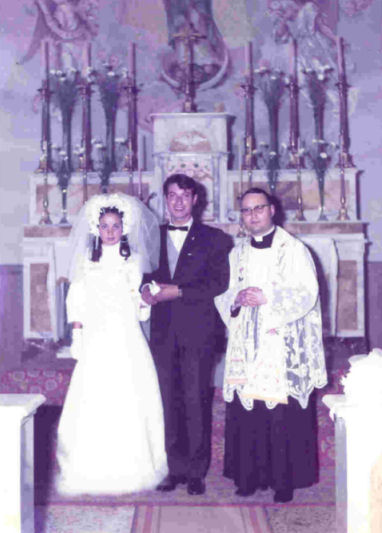
Born in Minervino di Lecce on 31 May 1918, he entered the seminary and was ordained a priest on 29 June 1943. Just days later, on 10 July 1943, the Archbishop of Otranto sent him to Galugnano — where the parish priest was gravely ill — appointing him administrator on 19 July and parish priest on 18 February 1944. This priest "come from elsewhere", small and seemingly frail, showed from the very start a strength of character and organisational ability well out of the ordinary, becoming over the years the true reference authority of the hamlet.
Highly active in politics to secure advantages for the community (from vote-trading to letters of recommendation), he personally led a very long series of public and religious works, of which he himself left a chronicle in two volumes: "Fede ed Arte a Galugnano" (1989) and "Riscontri e Testimonianze" (1990). Among his achievements: rebuilding the parish church (1951–1955), the bell tower (1956), the rectory, restoring the Annunziata church (1960), the parish hall (1961), extending the cemetery (1963), the war memorial (1965), the parish organ (1965), and restoring the Addolorata church (1973) and the church of Our Lady of the Snow (1978).
Two "blemishes" are still remembered against him today: the complete demolition of the sixteenth-century parish church, and the destruction of a menhir on via San Nicola during road-levelling works in 1955. Awarded civil and religious honours (Knight of the Republic in 1969, Chaplain of His Holiness in 1985), he left Galugnano on 5 October 2007, after more than sixty years as parish priest.
Dott. Paolo De Santis (1772–1830)
One of the most eminent figures Galugnano can claim. Born on 5 January 1772 (not 1769, as some historical sources have it), a physician esteemed across the province, he was head of the local "squadriglia" of the Filadelfi — a secret society of democratic, anti-Bonapartist leanings, widespread in Salento in the early nineteenth century on the model of freemasonry and the carboneria. His family was on close terms with the fallen Baron Massa family (Geronimo Massa and his wife were his godparents), and the story of Oronzo Massa — executed by the Bourbons for his pro-French sympathies — seems itself to have fed his love of the ideals of liberty.
He was the first Galugnano-born mayor of the central Università of San Donato di Lecce, from August 1818 to December 1823: another mayor from the town, not simply "appointed" from outside, would not come again until the podestàs of the Fascist era. He died on 9 March 1830. In the early decades of the twentieth century a town club would be named in his honour.
Don Donato Dell'Anna
A parish priest of deep spirituality and great learning, founder of the small but valuable parish library — which still holds a few sixteenth-century volumes today. Appointed parish priest in 1803 by Archbishop Morelli, as the historian Arditi writes, "he lived a life of blessing and died in 1850, mourned by all his parishioners." He left behind a detailed "Book of the State of Souls of the Parish of Galugnano", compiled at the end of 1849.
Padre Raffaele De Santis (1806–1882)
A Vincentian missionary, son of the notary Domenico De Santis. Around the mid-nineteenth century he oversaw the building of the palace known today as "Boccadamo", moving there with fellow friars when in 1865 the House of Savoy seized their convent in Lecce. Having entered the Congregation on 29 December 1826, he served as Superior of the Lecce house from September 1861 to 1866, in years of considerable tension between the State and the clergy. He died in Galugnano on 2 December 1882. For his connection to the town, see also Palazzo Boccadamo.
Prof. Gino Dell'Anna (1930–1992)
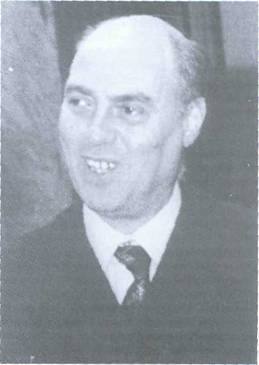
The pride of twentieth-century Galugnano's cultural life. He was born in Gallipoli on 21 June 1930 to Galugnano-born parents, graduating in chemistry in 1954 and devoting himself to scientific research: assistant, then associate professor of mineralogy at the University of Bari, professor of geochemistry and mineral deposits, gaining his lecturing qualification in 1971 and finally a full professorship in Mineralogy in 1975. He directed the Institute of Mineralogy and Petrography (1981–1983) and the Department of Geo-mineralogy (1983–1986).
He was the first to systematically study the minerals of Puglia's sedimentary formations — bauxites, red earths, limestones — and in the caves of Castellana he identified a previously unknown mineral, which he presented to science as francoanellite, in tribute to his friend Franco Anelli, discoverer of the caves. A founding member of the Italian branch of AIPEA (the study of clays) and a member of SIMP, he organised international congresses in Bari in 1976 and 1980. Ill for some time, he never let his suffering show and remained dedicated to his work until his final days. He died on 12 August 1992. A street in Galugnano now bears his name, as do streets named for Don Pippi Cucurachi and Sister Margherita Valente.
Oronzo Massa
A "wayward" figure of the Massa baronial family, lords of Galugnano for over a century. Having joined the Bourbon army, disgusted by the dictatorship he defected to the enemy and, under the Parthenopean Republic of 1799, rose to the rank of General. When the Bourbons returned, with the help of the English admiral Nelson, he was captured, executed by firing squad on 14 August 1799 and his body hung in the courtyard of the Carmine barracks in Naples — an episode that marked the beginning of the family's decline as feudal lords. For the full historical context, see Historical background.