Festivals, fairs, feast days and local cuisine
Galugnano is a genuine repository of Salento village life, one that finds its truest expression in its popular festivals:
The first Friday of March is the feast of Our Lady of Sorrows, with the fair of the "pampasciune" (a wild onion with a tuft, dug up to a depth of thirty centimetres around the town). After the service everyone brings home a small bag of "mustaccioli" (spiced biscuits) and two hundred lire's worth of mixed nuts; in the evening, sweets give way to pampasciuni washed down with wine, until the next year's gathering "alla Matonna 'Ndururata te Calignanu".
8 May brings "little St Michael", a prelude to the great patronal feast in September; until the 1950s it was also paired with a well-known livestock fair. The typical dish: local lamb, much sought after even outside Salento.
6 August is the feast of St Mary of the Snow, with a procession out to the field chapel and "li chiugghri ugghrati" (snails gathered during their summer dormancy) as the dish of the day.
23 September is "lu sparu": in memory of a violent storm that struck Galugnano in 1873, a solemn Mass and fireworks lasting up to an hour.
29 September, "big St Michael": the most keenly felt feast of the year, when Galugnano emigrants return home, with the fair "of the pig and the wild chicory" — the season's first slaughtered pig. A hymn to the Saint, by an unknown author, is performed every year by two bands, from a score commissioned by Michele Dell'Anna fu Bonaventura, President of the Patronal Feast Committee for 25 years.
8 December is the feast of the Immaculate Conception, patroness of the parish, with tastings of "pittule e purcegghruzzi" (fried dough puffs) in preparation for Christmas.
Folk costume
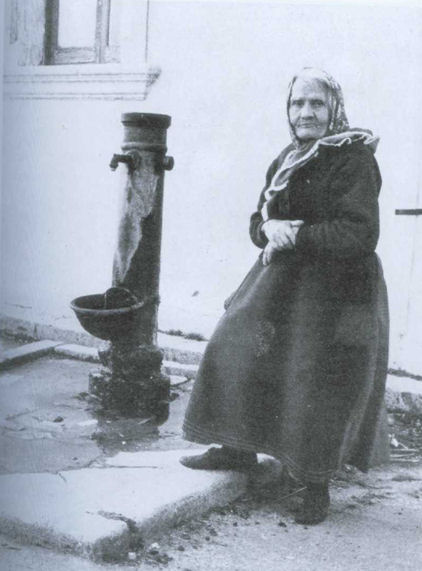
A record of the traditional local costume worn for the "matenate" (morning serenades), reconstructed from a photograph of one of the last Galugnano women to wear it, Michela Petrachi, and from a painting in the church of the Annunziata.
In women's dress, black dominates, owing to mourning customs: three years for parents, children and a spouse; six months for parents-in-law and siblings-in-law; three months for other relatives. With large families and a life expectancy of fifty to sixty years, women remained dressed in black for much of their lives. For men, white, sky blue, red and azure prevailed — colours chosen in the eighteenth century for the members of the Annunziata confraternity (white and sky blue) and present in the coats of arms of the Dell'Anna, Massa and Levanto families (red and azure).
Drawing on Irene Maria Malecore's description of Salento costume: men's dress featured a flat cap, a "camisola" (waistcoat), "causi" (trousers), a long coat ("giammerga") or short jacket ("salica"), stockings and shoes with silver buckles. Women's dress, richer still, included a shawl-like headdress, a bodice, the "mantesino" (a decorative apron) and an ankle-length skirt, gathered or pleated.
Le Cocule (the recipe)
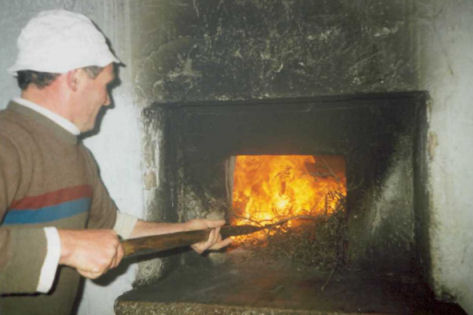
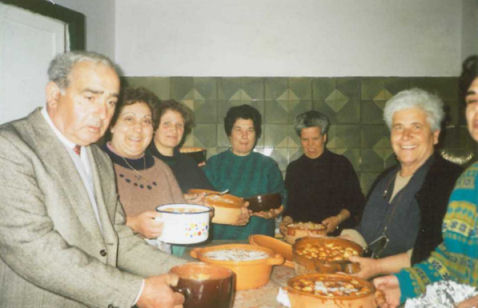
A dish traditionally made at Easter, born of necessity: with Lenten stores running low and meat a luxury for the few, grated stale bread, eggs and cheese were kneaded into patties and baked. The recipe (courtesy of Giovanni Maschio):
Ingredients (for a large, hungry family): the crumb of a 2 kg loaf of stale bread, 12 fresh eggs, 1 kg of grated cheese (Gavoi or pecorino, or a mix), parsley and pepper to taste.
Method: knead the bread crumb, eggs, cheese, a little salt and pepper (adding a splash of milk if the mixture is too stiff); form medium-sized patties and bake them in a terracotta dish, lined at the bottom with bread crusts to keep them from sticking. Dress with plenty of sauce (or chicken broth) and bake until golden.
It was strictly made on Holy Saturday: two batches, one at dawn and one in the early morning, taken out of the oven before the midday "Gloria". At the moment of the Resurrection, in church, people would stamp their feet and shake chairs to make noise — back home, hot, steaming cocule awaited.
La Quaremma
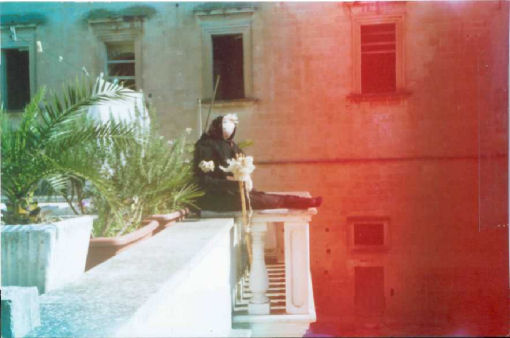
A tradition now nearly extinct: the display, on Ash Wednesday, of a straw figure — "la Quaremma", an old woman dressed in black holding a distaff and spindle, with seven barley rusks hanging from her waist (one removed each week until Easter). A symbol of penance, the figure seems to echo the Greco-Roman Fates; in later popular tradition she became the widow of Carnival ("Paulinu"), destined to be burned on Holy Saturday, after a life of hunger and hardship.
Christmas
The greatest anticipation was for the Christmas feasting and for the nativity scene, with its figures full of popular charm: "la picia", a shivering old woman with a brazier on her lap, a symbol of poverty; "frantoni" (Friar Anthony), a lay monk at work in the fields with sheep and goats; and, as prosperity arrived, even the butcher — unthinkable in the days when even water was scarce.
The Day of the Dead
On 2 November, children (and not only children) tied the four corners of a handkerchief to make a bag and knocked on every door to "ask", in remembrance of the dead, for walnuts, quinces, pomegranates, chestnuts, a handful of dried figs. Better-off families, after a recent bereavement, might even give 5 or as much as 10 lire — news that spread quickly among the children going door to door.
The Spanish flu
In 1918 the "Spanish" flu epidemic, which caused roughly 20 million deaths worldwide, hit Galugnano hard too: against an average of fewer than two deaths a month, October 1918 saw six and November ten. By December things had returned to normal, with only two deaths. Notably, of the 18 victims, 14 were women and only 4 men.
Hunger returns
During the First World War, more than the fighting itself — which was far away — Galugnano feared hunger: large families, the strongest hands away at the front, winters without firewood. Day labourers were often paid in broad beans or dried peas; olive-tree roots were secretly dug up to heat homes. Shepherd children, taking the sheep out to graze, quickly learned to milk their neighbours' animals in secret, risking serious trouble if the milk didn't add up come evening.
Village life
Until the mid-twentieth century, the life of those who worked the land was extremely hard: every family kept two sheep, a piglet and a few hens, which grazed freely in the streets and made their own way home by evening. Homes were often a single room plus kitchen, the bathroom a squat toilet dug in the garden plot, the donkey's stable close by. The rutted, dusty streets came alive at dawn and emptied out quickly, broken only by the calls of travelling pedlars: "Oliiio, petrolio, spirito, flitti, crema!!" ("Oil, paraffin, spirits, insecticide, polish!"), "Uliiie, ci teeeene uliiie!!" ("Olives, who wants olives!"). Manure gathered from the street went into the family's compost, essential for the area's rocky, "bitter" soil.
20th century — the postwar years
Even before the war had fully ended, Galugnano and San Donato were already breathing the air of normalisation: the Fascist-era podestà gave way to a Council with a mayor and aldermen. On 19 February 1945 the Council named two streets after Giacomo Matteotti and 25 July 1943, a clear sign of the new anti-fascist climate. On 1 June and 1 July 1945 new fares were set for public and private carriages and for the vehicle licence tax. But the real turning point was the first free election for the Town Council, on 10 March 1946, preceded by months of intense preparation: a heated campaign fought between the lists of Luigi Mazzeo and Michele Conte.
Television, and the end of games and pranks
Television arrived in 1955: two years later the first set was installed in Galugnano, at the Bar Manna, to the general amazement of a crowd of children gathered around the technician. Television radically changed how people spent their free time, marking the decline of age-old traditions such as the "battle of the bitter oranges" for St Lazarus, the propitiatory bonfires, and group games like hide-and-seek, cops and robbers, "tizza", "stacce" and "linca" — as well as of fierce pranks such as bricking up someone's door at night or sending grandfather's hat flying with a clothes-peg tied to a length of string.
L'Uru
A small, mischievous goblin of Salento tradition, known elsewhere as "scazzamurieddhru", "monacieddhru" or "laurieddhru" — perhaps from the Latin lares (household protectors) or urere (to torment). Tiny, with a little red cap taller than himself, folk tradition holds that he makes objects disappear, torments animals, tangles women's hair at night and, if angered, sits on the chest of sleepers and smothers their breath. One tale tells of a family so exasperated they tried to move house to be rid of him — only to find that the Uru had followed them, sitting comfortably on grandmother's broom.
Culacchi
The "culacchi" are short folk tales, implausible but carrying a strong moral. Among the best known, "Ecchiaia" (Old Age): once, anyone who passed the age of fifty was taken by their children to be drowned at sea. Michele thus carries his father towards San Foca, but along the way the old man suggests a riddle that will save them both before the King — "a shower in March and April is worth more than your carriage all of gold" — proving that the wisdom of the old is worth more than any riches. Michele's father, discovered hiding under the bed, not only keeps his life but becomes a royal advisor.
Lu Ccippi
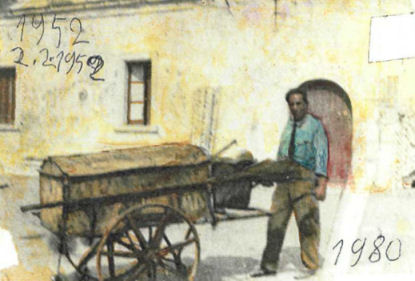
Giuseppe Peccarisi, known to all as "Ccìppì", was the last of Galugnano's street sweepers, in service until 1975: small, slight, limping on one leg, he made his way through the town's empty streets with his inseparable mobile bin — a box on two bicycle wheels, fitted with a broom, a "cardarina" (a repurposed builder's container), a sheet of metal in place of a dustpan, and the "sarchiugghra" for weeds. A symbol of an age spanning the postwar years to the 1980s, when household waste — mostly biodegradable — still ended up on the family's own manure heap.