Historical notes drawn from "Galugnano — una storia minore" by F. M. Dell'Anna, illustrated by architect L. M. Dell'Anna.
Historical background
Galugnano is a cluster of houses clinging to the slopes of a hill in the Salento hinterland, 11 km from Lecce along the state road that leads from Lecce to Maglie.
Its origins are lost in the mists of time. As the nineteenth-century historian Arditi wrote: "It is believed to have been founded by the Greek-Iapygians in the year of the world 2000." Just which historical date "the year of the world" refers to is disputed: according to one major encyclopedia, the creation of the world is generally placed between 5500 and 5000 BC — if so, Galugnano would have been founded around 3500 BC.
The philosopher and physician Girolamo Marciano of Leverano instead dated the birth of Christ to the year 3960 of the world's creation: by his reckoning, Galugnano's founding would fall around 1960 BC.
The historian Luigi Tasselli writes that Idomeneus, son of Deucalion, gathering the scattered peoples of the region, built Lecce in the year 2708 after the creation of the world. To that same Idomeneus, Prof. Saverio La Scorsa attributes — after his wanderings in search of new lands — the founding of Castro, Galatina, Diso, Nardò, Soleto, and Galugnano as well.
Bearing witness to the prehistoric occupation of the area, menhirs, specchie (dry-stone watch-cairns) and dolmens are scattered across the whole of Salento. Galugnano can claim two specchie (one now vanished), three menhirs (one destroyed), two settlement sites in the areas known today as "Siosti" and "Ussano", and the "Lete" site. "Delle Lete" and "Curti Ecchi" are the two menhirs that survive.
Salento, like the whole of Puglia, though inhabited since the third millennium BC, enters recorded history with the landing of peoples from Illyria and Epirus. The Greeks called these peoples Iapygians, distinguishing among them the Daunians, the Peucetians and the Messapians — the latter, settled in Salento since prehistoric times, left Galugnano its numerous specchie.
That Galugnano has Greek roots is suspected by the historian Giacomo Arditi: "The buildings are nearly all ancient, rustic... some still show doors and windows of Greek fashion," and further, "at one time they spoke Greek, no longer so today... its name might perhaps derive from the Greek Kalos (beautiful)" — a hypothesis the present author does not share. Giovanni Colella instead suspects the town is called "Gallunium" in a Greek document of 1401, and that "Galunius" may have been a Greek name.
Two informal inscriptions survive as evidence: one in the Chapel of Our Lady of the Snow, the other in the Dellanos baronial palace ("Cainayanon: Galugnano in a sort of Greek-derived dialect?"). Galugnano, in any case, lies within the area of Grecìa Salentina, today officially recognised: from a "scattered" settlement pattern — Galugnano, Lete, Siosti, Ussano — the area shifted to an "aggregated" form in which Galugnano absorbed the other three sites.
The Roman conquest of Puglia begins in the third century BC and continues until 476 AD, the fall of the Western Roman Empire. Salento was conquered in 266 BC and lost in the sixth century AD: Lecce was taken by Totila, king of the Ostrogoths, in 542 AD, retaken by the Byzantines in 547, and recaptured by Totila in 549. From this period survive the very name of Galugnano and the Roman paving of the steep descent known as "la Scaligghra", today covered in asphalt.
Almost entirely vanished are "le puzze" (the wells — once twenty-one of them — an archaic system for collecting rainwater). Numerous and well preserved, on the other hand, are "i paiari", small dry-stone field shelters that, even where not themselves ancient, certainly preserve the ancient building technique.
According to Luigi Tasselli, many of the place-names of the Capo di Leuca area ending in "-ano" were once the estates of Roman soldiers and centurions, hence the suffix. Giovanni Colella echoes the point: Martignano from Martinus, Squinzano from Quinzio, Magliano from Manlio, Melpignano from Melpinius, Arnesano from Arnio — and Galugnano from Galonius.
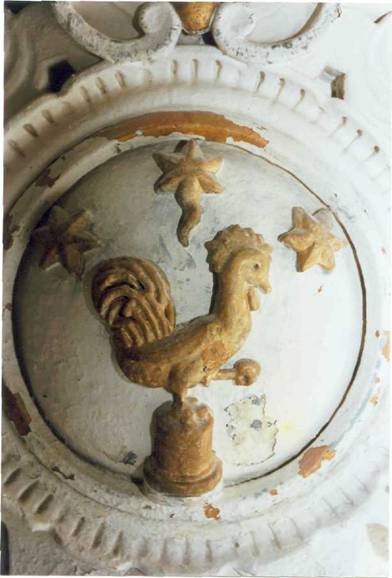
Before its current form, the name passed through Calignanu, Calugnanu, Galignano and Gallomano: this last form points to the civic coat of arms which, like that of Gallipoli, prominently displays a rooster (Gallo-niano, Galli-poli).
As for the feudal successions: they begin in 1192, when Tancred of Hauteville, Count of Lecce, granted Galugnano to Giorgio Remanno. In 1285 the lords and masters became the Dell'Acaya family, invested by Charles II of Anjou — the most notable of them for his genius being the architect Gian Giacomo, whose extravagance nonetheless forced his heirs to sell the barony on 6 October 1587 to Ramirez Dellanos, a Spanish administrator of justice in Lecce. A poor administrator, he ended up in debtors' prison, strangled by the debts run up partly in building his own palace; on 15 March 1621 Dellanos sold everything to Nicolò di Andrea Levanto, a Genoese who had settled in Naples.
The sixteenth century saw the building of the parish church, later demolished in the twentieth. Under the Levanto family the two churches of the Annunziata and of Our Lady of Sorrows were built. Weighed down by debt, on 9 May 1695 the Levanto family sold the Galugnano estate to Gio: Geronimo Massa, a nobleman of Lecce.
The Massa family governed for over a century, well loved and respected — although the best-known member of the house is the "wayward" Oronzo Massa who, having joined the Bourbon army and then defected to the enemy, rose to the rank of General under the Parthenopean Republic of 1799. When the Bourbons returned with the help of Admiral Nelson, he was executed by firing squad on 14 August 1799 and his body hung in the courtyard of the Carmine barracks in Naples.
In 1810, in the wake of the Napoleonic upheaval, Murat issued decrees abolishing the baronies: it was the end of the Massa family as feudal lords. The Università (municipal body) of Galugnano was merged with that of San Donato di Lecce and, in 1866, with the arrival of the House of Savoy, reduced to the rank of a hamlet of San Donato di Lecce.
Worth remembering: in the 1860s, the building of Palazzo Boccadamo, and in the 1950s, the demolition of the old parish church and the building of the new one under parish priest (later Monsignor) Pasquale Caputo.
Among the notable figures of Galugnano: at the turn of the eighteenth and nineteenth centuries, the notaries Pasquale and Vincenzo Licastro, father and son, and Domenico De Sanctis. In the nineteenth century, Dott. Paolo De Sanctis, head of the local "Filadelfi" and mayor of the central Università of San Donato, a man of high ideals of liberty and democracy. In the twentieth century, the pride of the small community: Prof. Gino Dell'Anna.
Gino Dell'Anna was born in Gallipoli on 21 June 1930. He graduated in chemistry in 1954 and devoted himself to scientific research: assistant, then associate professor of mineralogy at the University of Bari, later professor of geochemistry and mineral deposits, gaining his lecturing qualification in 1971 and a full professorship in 1975. He directed the Institute of Mineralogy and Petrography from 1981 to 1983 and the Department of Geo-mineralogy from 1983 to 1986. In the caves of Castellana he identified a previously unknown mineral, which he presented to science as "francoanellite" in tribute to his friend Franco Anelli, the discoverer of the caves. He died on 12 August 1992: the University of Bari has since dedicated a lecture hall to him, and Galugnano a street.
Civic coat of arms
Heraldic coats of arms first appeared in the twelfth century to distinguish combatants in war and in tournaments, but it was only between the late fifteenth and early sixteenth centuries that their use became widespread. As the historian Salvatore Panareo writes, in the general enthusiasm for adopting an emblem — even without any real tradition behind it — Gallipoli's choice of the rooster was almost automatic, drawing on the legendary Idomeneus said to have introduced it.
Galugnano, like Gallipoli and very probably in the same period, chose a bold rooster standing on a column stump, surmounted by three staggered six-pointed stars — the central one, set higher than the other two, representing a comet. The last and today the only surviving example is carved on the seventeenth-century altar frontal of the Archangel Michael in the parish church; another, now lost, once stood on the oval above the altar of the Sacred Heart, also in the parish church, and a further one on the façade of the old elementary school in Piazza Vittorio Emanuele II.
The rooster is a symbol of the valiant warrior, of vigilance, of courage, of victory and of health.
Note: quotations and source titles above are translated for readability from the original Italian sources cited in the book "Galugnano — una storia minore" (see the footnotes on the Italian version of this page for full bibliographic references).