The parish church
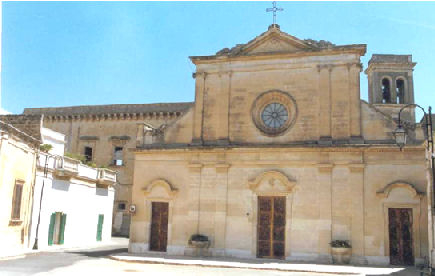
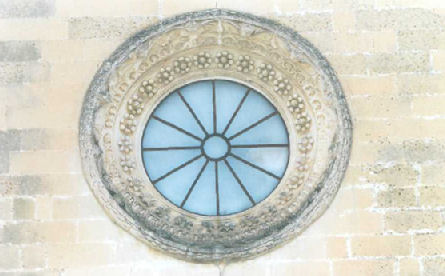
The earliest known parish church is that of San Nicola, already described as "ancient" in 1522. At the end of the sixteenth century it was replaced by a church dedicated first to St Mary of the Assumption and later to the Immaculate Conception: the altar of the Archangel Michael bears the date 1605, and the works were completed in 1618, as recorded on the main door. In 1912–13 the church was enlarged by about 20 square metres and its façade rebuilt three metres further forward, keeping only the original circular rose window.
The real turning point came with Don Pasquale Caputo (later Monsignor), who arrived on 10 July 1943. In 1951 he began an extension with two side aisles, but the large pillars this required ended up blocking the view of the altar: in 1952 it was decided to demolish the old church entirely and rebuild it. Work finished in 1955: it was inaugurated on 7 May, with the blessing of Archbishop Mons. Raffaele Calabria. The total cost was 10,769,375 lire, partly covered by the State, by the Pope, and by a public collection of over 3.4 million lire.
The bell tower followed in 1956, and a new organ in 1965 (built by the Bevilacqua firm of L'Aquila). Over the years the interior was enriched with pews, Stations of the Cross, a marble balustrade and pulpit, and apse frescoes by Americo Buscicchio and Umberto Colonna. In 1993, for the fiftieth anniversary of Mons. Caputo's ordination, the central bronze door with its eight panels was unveiled; in 1998 the two side doors followed, the work of Maestro Lorenzo Ciccarese.
Chapel of Our Lady of the Snow
Already known as the "Abbey of St Mary of the Snow" or "of the Pisanei" in sixteenth-century documents held at the Diocesan Archive of Otranto, the small church — probably built in the fifteenth century — holds restored frescoes inside. It stands in open countryside outside the town walls, the destination of an ancient procession every 6 August (see also Festivals & fairs).
Church of the Annunziata and church of the Addolorata
The church of St Mary of the Annunciation, built in 1665, is considered a true jewel of Salento baroque. The cemetery church of Our Lady of Sorrows, from 1675, stands instead on a "cunegghra" (a pre-existing small chapel) and preserves, in a two-altar arrangement, its original ancient icon.
Palazzo Boccadamo
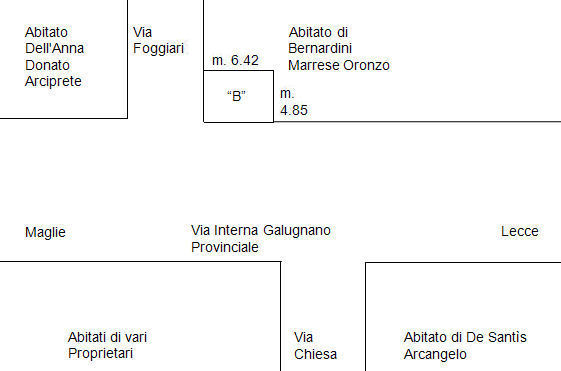
The rear of the palace shows sixteenth-century traces, while the main façade is linked to the old church of St John the Baptist, which stood on the site until the first half of the nineteenth century. In 1774 the building belonged to the Lecce nobleman Francesco Prato; by 1809 it was home to the notary Domenico De Santis.
Around 1860–65 the notary's son, Padre Raffaele De Santis (a Vincentian missionary), had the main façade built and raised a chapel dedicated to St John the Evangelist. In 1866, when the House of Savoy seized the Vincentians' convent in Lecce, the palace became for a time the seat of the Missionary Fathers. On Padre Raffaele's death (1882) the property passed to the Missionary Fathers, who sold it in 1886 to Oronzo Bernardini Marrese. By 1911 the palace belonged to the lawyer Domenico Boccadamo, who carried out a careful restoration. Today it belongs to the Cucurachi family, following the marriage of Donna Maria Boccadamo to the local doctor Don Pippi Cucurachi.
Palazzo Dellanos
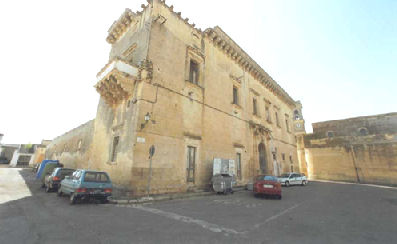
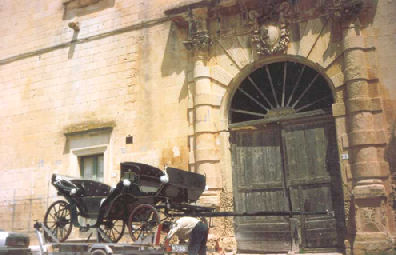
It is impossible to establish an exact building date: there are no inscriptions, and the works — carried out intermittently — remain unfinished to this day. The Royal Bailiff Ramirez Dellanos, having purchased the fief of Galugnano from the Dell'Acaya family on 6 October 1587, probably began work soon after on a quadrangular two-storey building with a large interior garden — completing in this first phase only the south wing and the front section up to the entrance gate. Certain features, including a monumental fireplace, suggest that parts of a pre-existing structure were absorbed into the design.
Palazzetto Camataro and the Dell'Acaya Arch
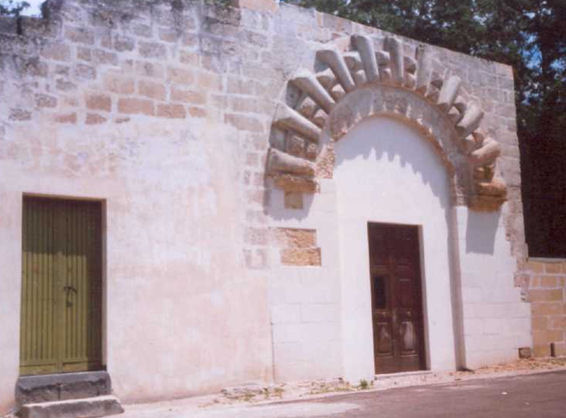
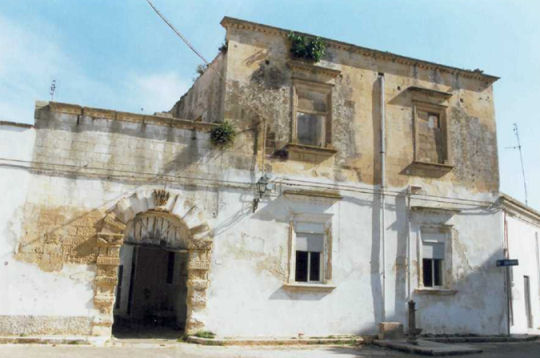
The Dell'Acaya family governed the barony for 303 years (1284–1587) without ever residing there permanently, managing it instead through governors. The sixteenth-century arch on via Pozze, restored by the national roads authority ANAS, is attributed by the scholar Michele Paone to the architect Gian Giacomo dell'Acaya, on the basis of similarities with the Holy Spirit Hospital in Lecce. The nearby small palace in Largo Umberto I was instead the residence of the Camataro governors, later opposed by the new baron Ramirez Dellanos after his purchase of the barony.
War memorial
In 1921 a committee of citizens obtained authorisation from the Comune of San Donato di Lecce to erect, in Largo Giordano, a commemorative column in Lecce stone for the Galugnano men who fell in the Great War. The column stood until 1965, when it was replaced by the current memorial, sponsored by Mons. Pasquale Caputo to a design by Nino Sisinni of Maglie and funded by public subscription together with a municipal contribution of 100,000 lire.
Wayside shrines and courtyard houses
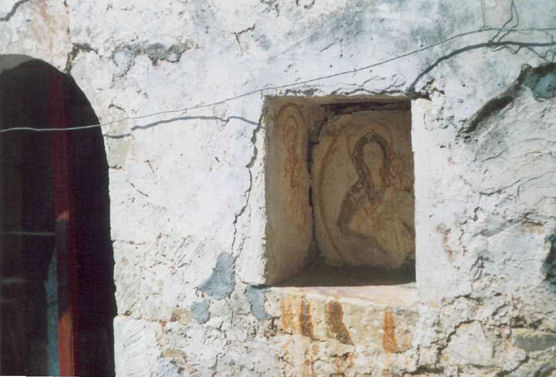
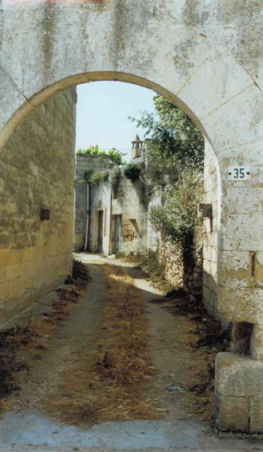
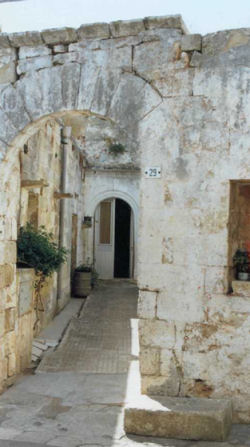
The historic centre of Galugnano preserves numerous small votive shrines, built between the sixteenth and twentieth centuries — evidence of a widespread popular devotion, often linked to graces received. Among the most notable: the shrine of St Anthony on via Pozze (from the 1940s), the sixteenth-century frescoes in the courtyard of San Francesco, Our Lady of Providence (early seventeenth century), the shrine of St Michael in Piazza Umberto (commissioned by Michela Arcangela Peccarisi for a grace received), a naïve mid-nineteenth-century Madonna and Child on via San Salvatore, and the shrine of St Lazarus — once the focus of the popular feast "Santu Lazzaru te le marange", with propitiatory bonfires and the traditional "battle of the bitter oranges", which disappeared with the Second World War.
Menhirs, dolmens and specchie
Evidence of prehistoric settlement is scattered across the Galugnano countryside. The "delle Lete" menhir, 4.70 m tall, is the second tallest of all Salento menhirs; the "Curti Ecchi" menhir near the railway station stands 3 metres tall. A third menhir once stood on via San Nicola, destroyed in 1955 during road-levelling works ordered by Mons. Caputo.
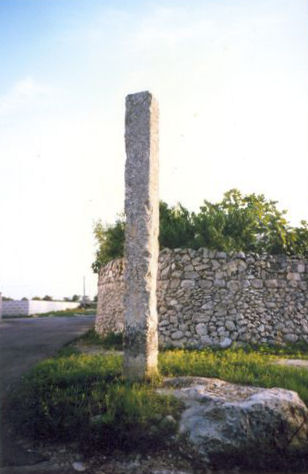
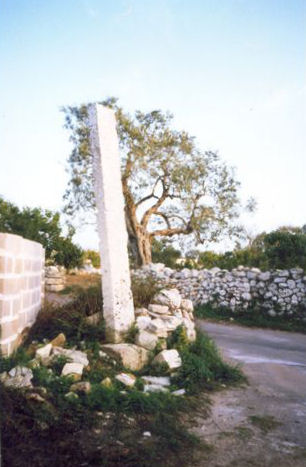
Dolmens (from the Breton dol, table, and men, stone) are shapeless monoliths, either single or dry-stacked, forming columns that support a slab of raw stone: burial sites, altars or places of worship, according to different hypotheses.
Specchie — from the Latin specula, watchtower — were probably lookout posts, built by stacking blocks of stone using the same technique as the "pajari" field shelters. According to the scholar De Giorgi they could reach 15–25 metres in height, comparable to the tallest Sardinian nuraghi, and are generally attributed to the Messapians, who arrived in Salento from Illyria around 1000 BC. In the countryside towards San Salvatore stands the "specchia Caggiune", also known as "the devil's specchia" for a local legend about a hidden treasure — a golden hen with twenty-one chicks, guarded by a spell that can only be broken at midnight, on a full-moon night, accompanied by a priest and a goat.
The "Cunegghra" of Our Lady of the Milk
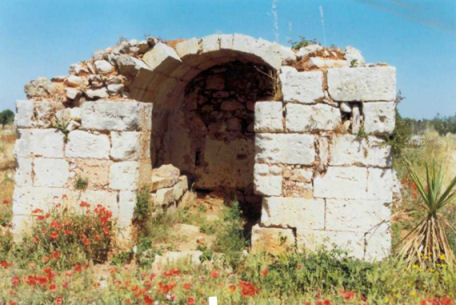
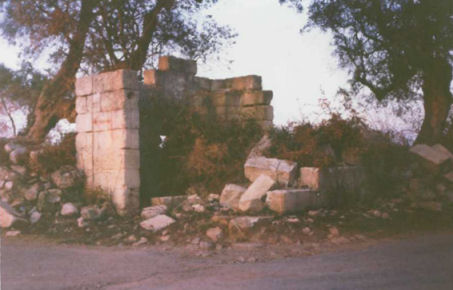
The "cunegghre" (from the Latin conella) were tiny field chapels built along the edges of old country roads, each holding an icon — almost always of the Virgin Mary — offering farmers, shepherds and travellers a moment's rest and prayer. Many of Galugnano's churches stand on the site of just such a pre-existing "cunegghra". The one dedicated to Our Lady of the Milk, on the old road to Soleto three kilometres from the town, is today reduced to a heap of ruins, its ancient icon of the nursing Virgin now lost.
Lu Paritune
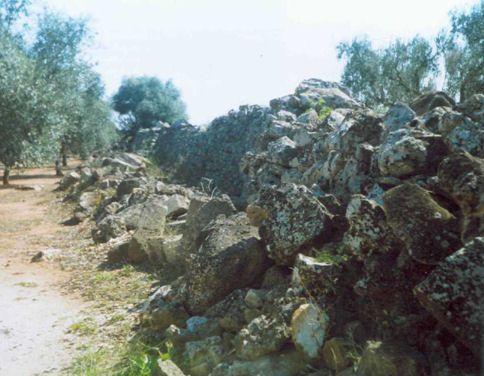
An imposing dry-stone wall — over two metres wide at the base — running for kilometres across the Galugnano and Specchia Rosa estates as far as Soleto. Thinned over time by road- and airfield-building, it may once have marked the ancient boundary between the territories of Soleto and Lecce, or it may correspond to the "limitone" of an ancient Messapian road — mentioned also by Strabo — that linked Otranto to the Appian Way by way of Cavallino and Oria.